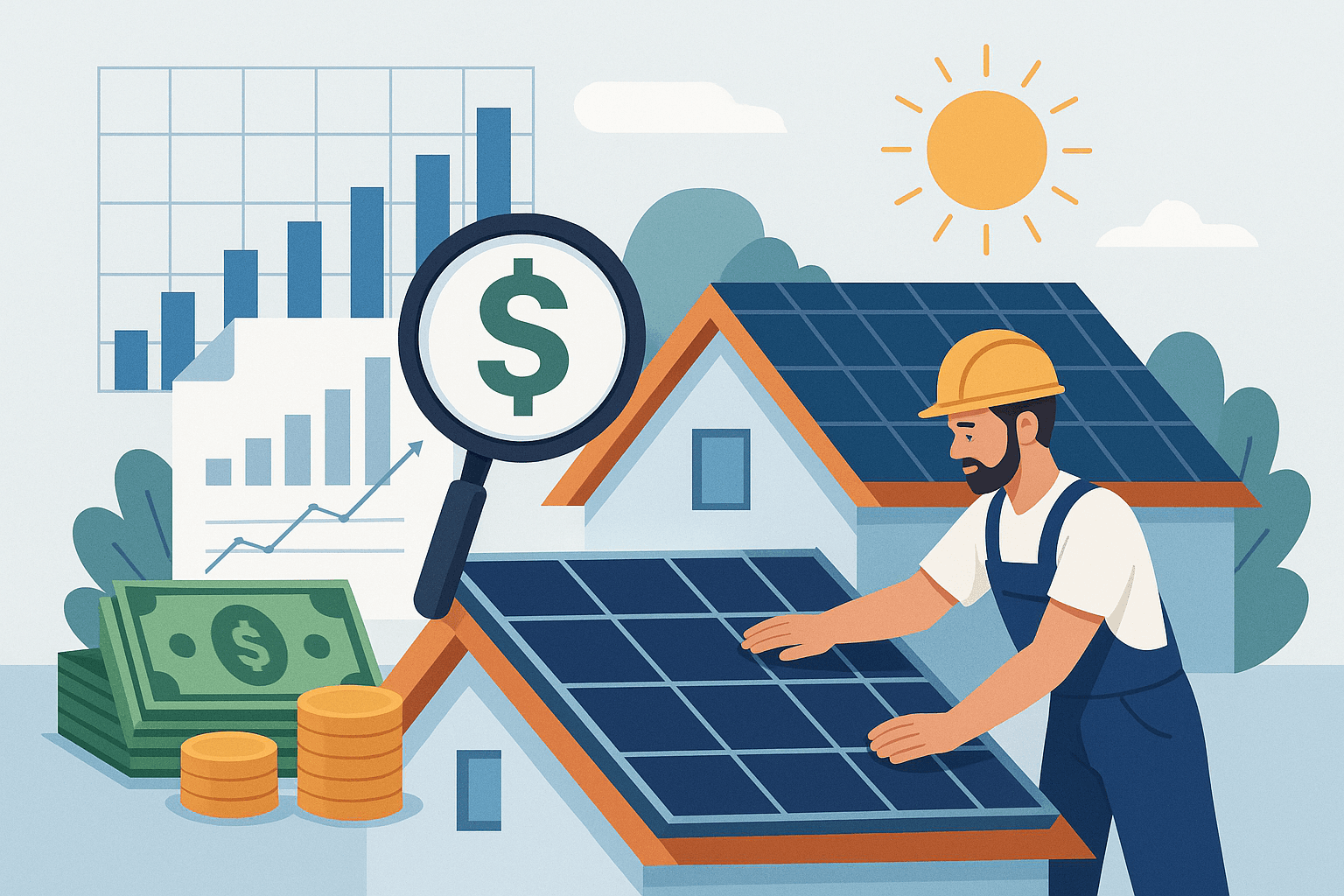
Solar panel installation costs an average of $16,000–$35,000 for a typical residential system in 2026, before the federal solar tax credit. After the 30% federal Investment Tax Credit (ITC), most homeowners pay $11,200–$24,500 out of pocket. The wide range reflects system size, roof type, installer, and location. This guide breaks down exactly what drives cost, what the average payback period looks like, and how to evaluate quotes from solar installers.
How We Analyzed Solar Installation Costs
| Factor |
Impact on Cost |
Why It Matters |
| System size (kW) |
High |
Directly scales total panel + labor costs |
| Panel brand/efficiency |
High |
Premium panels cost 20–40% more |
| Roof type and condition |
Medium |
Tile and metal roofs add $1,000–$3,000 in labor |
| State incentives |
High |
State tax credits + utility rebates reduce net cost 5–30% |
| Installer margin |
Medium |
Local vs. national installers vary by $2,000–$6,000 |
| Battery storage add-on |
High |
Adds $8,000–$15,000 to base system cost |
Data sources: NREL (National Renewable Energy Laboratory) 2026 cost benchmarks, Lawrence Berkeley National Laboratory Tracking the Sun report, EnergySage marketplace data 2025–2026, IRS Publication 946 (ITC guidance).
1. Average Cost by System Size — The Core Benchmark
Best for: Understanding baseline costs before getting quotes
Key metric: $2.50–$4.00 per watt installed (industry benchmark, 2026)
Most common residential size: 6–10 kW system
The cost per watt installed — covering panels, inverter, racking, labor, permits, and interconnection — ranges from $2.50 to $4.00 in 2026, with the national average sitting around $3.00/watt according to NREL's Q1 2026 benchmark report.
Estimated total cost by system size (before ITC):
| System Size |
Avg Daily Output |
Estimated Cost |
After 30% ITC |
| 4 kW |
16–20 kWh/day |
$10,000–$16,000 |
$7,000–$11,200 |
| 6 kW |
24–30 kWh/day |
$15,000–$24,000 |
$10,500–$16,800 |
| 8 kW |
32–40 kWh/day |
$20,000–$32,000 |
$14,000–$22,400 |
| 10 kW |
40–50 kWh/day |
$25,000–$40,000 |
$17,500–$28,000 |
| 12 kW |
48–60 kWh/day |
$30,000–$48,000 |
$21,000–$33,600 |
Pros
- Right-sizing your system prevents overpaying for unused capacity
- Smaller systems have faster payback periods
Cons
- Undersizing means you still pay utility costs for excess consumption
- Future EV charging or heat pump addition may require expansion
Who This Is Best For
Homeowners with annual electricity bills between $1,200–$2,400 typically need a 6–8 kW system. Your utility bills from the past 12 months are the best starting point for sizing.
2. The Federal Investment Tax Credit (ITC) — 30% Off Through 2032
Best for: All homeowners — this is the most impactful incentive available
Savings: 30% of total system cost, applied to your federal tax liability
Expiration: 30% rate guaranteed through 2032 under the Inflation Reduction Act
The federal solar Investment Tax Credit (ITC) allows you to deduct 30% of your solar installation cost from your federal income taxes in the year of installation. On a $20,000 system, that's a $6,000 direct reduction in taxes owed — not a refund, but a dollar-for-dollar reduction.
How it works
File IRS Form 5695 with your federal return for the year installation is completed. The credit applies to panels, inverter, labor, permits, and battery storage (if installed simultaneously). You must own the system (not lease it) and have sufficient tax liability to absorb the credit — unused portions roll forward to the next tax year.
Pros
- 30% rate locked in through 2032 — no urgency to rush
- Applies to battery storage added at the same time
- Carryforward available if your tax liability is less than the credit amount
Cons
- Does not apply to leased systems or PPAs (power purchase agreements)
- Requires federal tax liability to claim — low-income households may not benefit fully
- Does not reduce your state income tax (separate state credits handle that)
Who This Is Best For
Any homeowner who purchases their solar system outright or via loan — not lease. If you're considering a solar lease, run the 25-year cost comparison carefully; you forgo the ITC.
3. State Solar Incentives — The Often-Missed Layer
Best for: Homeowners in incentive-rich states (CA, NY, MA, TX, AZ, NJ)
Potential additional savings: $1,000–$10,000+ depending on state
On top of the federal ITC, many states offer additional tax credits, property tax exemptions, sales tax exemptions, and utility rebates. The cumulative impact in high-incentive states can reduce effective cost by an additional 15–25%.
Top state solar incentive programs (2026):
| State |
Key Incentive |
Est. Value |
| New York |
25% state tax credit (max $5,000) |
Up to $5,000 |
| Massachusetts |
15% state tax credit + SMART program |
$2,000–$6,000+ |
| New Jersey |
TREC solar certificate program |
$1,500–$4,000/year |
| California |
SGIP battery incentive (storage) |
$200–$400/kWh |
| Texas |
Property tax exemption on added value |
$500–$3,000/year |
| Arizona |
25% state credit (max $1,000) + sales tax exempt |
$1,000–$3,000 |
Pros
- Property tax exemptions mean solar doesn't raise your property taxes (available in 36 states)
- Sales tax exemptions save 4–10% of hardware costs where applicable
Cons
- State programs change annually — verify current availability at DSIRE (dsireusa.org)
- Some utility rebates are first-come, first-served and exhaust early in the year
Who This Is Best For
Every homeowner should check DSIRE (the Database of State Incentives for Renewables & Efficiency) before signing an installer contract. Installers don't always mention all available incentives.
4. Solar Loan vs. Cash Purchase vs. Lease — Financing Economics
Best for: Homeowners evaluating how to pay for solar
Key decision: Cash purchase gives best ROI; loan adds 15–25% to total cost; lease forfeits ITC
Cost comparison for a $20,000 system (before incentives):
| Method |
Net 25-Year Cost |
You Own System |
ITC Available |
Avg Monthly Savings |
| Cash purchase |
$14,000 (after ITC) |
Yes |
Yes |
$100–$200/mo |
| Solar loan (5.99% APR, 12 yr) |
~$21,000 total payments |
Yes |
Yes |
$40–$120/mo |
| Lease / PPA |
$0 down, ~$18,000 total payments over 20 yr |
No |
No |
$10–$60/mo |
Pros of cash purchase
- Highest ROI — full ITC captured, no interest paid
- Increases home value (NREL: solar adds ~3.5% to median home price)
Cons of cash purchase
- Requires $14,000–$24,000 liquid capital after ITC
Pros of solar loan
- No upfront cash required
- You own the system and capture the ITC
Cons of solar loan
- Interest costs reduce total savings by $3,000–$7,000 over loan term
- Monthly payment must be less than your current electric bill for immediate cash flow benefit
Pros of solar lease / PPA
- $0 down, immediate savings
- Maintenance typically included
Cons of solar lease
- No ITC benefit
- Lease payments often escalate 2–3%/year
- Complicates home sale (buyer must assume lease or it must be bought out)
Who This Is Best For
Cash purchase is best if you have the capital. A solar loan works well if you can secure under 7% APR. Avoid leases unless your state has no state tax credits and you genuinely cannot access financing — the economics are structurally inferior for most homeowners.
5. Battery Storage Add-On — What It Costs and When It Makes Sense
Best for: Homeowners in areas with time-of-use rates, frequent outages, or no net metering
Cost: $8,000–$15,000 for a 10–13.5 kWh battery (installed), before incentives
Adding a battery (Tesla Powerwall 3, Enphase IQ Battery, Franklin Electric) allows you to store excess solar energy and use it at night or during outages. At 2026 prices, battery payback is typically 8–12 years on its own — but the federal ITC now covers battery storage if installed with solar.
2026 battery storage costs (installed):
- Tesla Powerwall 3 (13.5 kWh): $11,500–$13,500
- Enphase IQ Battery 10 (10.5 kWh): $9,500–$12,000
- Franklin Electric aPower2 (13.6 kWh): $9,000–$11,000
After 30% ITC: $6,300–$9,450 net cost for storage.
Pros
- ITC now applies to standalone battery storage (2023 IRA expansion)
- Essential if your utility has eliminated net metering
- Provides backup power during grid outages
Cons
- Long standalone payback period (8–12 years)
- Not cost-effective if your utility has strong net metering compensation
Who This Is Best For
Homeowners in California (NEM 3.0 reduced export compensation), Texas (no statewide net metering), or any area with 4+ outages per year. Also relevant for homeowners with EVs who want to charge overnight from stored solar.
6. How to Evaluate Solar Quotes — 4 Numbers That Matter
Best for: Homeowners actively soliciting installer quotes
Key insight: The lowest price per watt isn't always the best deal
When comparing installer quotes, focus on these four numbers:
- Cost per watt (installed): Should be $2.50–$4.00. Above $4.50 is overpriced for most markets.
- System production guarantee: Look for 90%+ production at 10 years, 80%+ at 25 years in panel warranty.
- Payback period: Target 6–10 years. Above 12 years, the economics are marginal.
- Net cost after incentives: Ensure the installer includes ITC, state credits, and any utility rebates in their estimate.
Pros of getting 3+ quotes
- EnergySage research shows homeowners who get 3+ quotes save an average of $5,000–$10,000 vs. going with the first installer
- Exposes installer margin variability in your market
Cons
- Sales process can be high-pressure — don't sign same-day
- Cheaper installers may use off-brand panels with shorter warranties
Who This Is Best For
Every homeowner. Use EnergySage.com or the NREL installer database to find NABCEP-certified installers in your area. Avoid door-to-door solar salespeople without checking their installer credentials first.
Quick Comparison: Solar Installation Cost Summary 2026
| Factor |
Low End |
High End |
Key Driver |
| System cost (6–8 kW) |
$15,000 |
$32,000 |
Panel brand + labor |
| After 30% federal ITC |
$10,500 |
$22,400 |
Tax liability required |
| After state incentives |
$8,500 |
$20,000 |
State-dependent |
| Battery add-on (after ITC) |
$6,300 |
$9,450 |
Brand + capacity |
| Payback period |
5 years |
14 years |
Usage + incentives + rate |
| 25-year net savings |
$20,000 |
$60,000 |
System size + utility rate |
How We Researched This
This guide draws on NREL's Q1 2026 Residential Solar Cost Benchmark, Lawrence Berkeley National Laboratory's Tracking the Sun database, EnergySage 2025–2026 marketplace pricing data, and IRS Publication 946 for ITC guidance. Battery costs from manufacturer published retail pricing. State incentive data from DSIRE (dsireusa.org). Last updated: May 2026. We review this guide semi-annually.
Frequently Asked Questions
How much does solar panel installation cost in 2026?
The average residential solar installation costs $16,000–$35,000 before incentives, or $11,200–$24,500 after the 30% federal Investment Tax Credit. A typical 6–8 kW system for a median-sized home costs approximately $18,000–$26,000 before the ITC.
What is the federal solar tax credit for 2026?
The federal Investment Tax Credit (ITC) allows homeowners to deduct 30% of their solar installation cost from their federal income taxes. On a $20,000 system, that's a $6,000 credit. The 30% rate is guaranteed through 2032 under the Inflation Reduction Act.
How long does it take for solar panels to pay for themselves?
The average solar payback period in 2026 is 6–10 years, depending on system cost, local utility rates, available incentives, and your home's solar production potential. After payback, most systems produce essentially free electricity for 15+ more years.
Does solar increase home value?
Yes. NREL research shows solar adds approximately 3.5% to median home resale value, or about $15,000 for a $430,000 home. The premium is strongest in markets with high utility rates and strong solar awareness (California, Massachusetts, New York, New Jersey).
Should I buy or lease solar panels?
Buying (cash or loan) is almost always better economics. You capture the 30% federal ITC (which lessens alone reduces cost by $6,000+ on a typical system), build home equity, and avoid the complications of a lease during home sale. Solar leases make financial sense primarily in states with no state tax credits and high installer loan rates.
How do I find a good solar installer?
Get at least 3 quotes. Use EnergySage.com for pre-vetted installers, or search the NABCEP (North American Board of Certified Energy Practitioners) directory for certified installers in your area. Avoid signing same-day after a door-to-door sales presentation.
What size solar system do I need?
Divide your annual electricity consumption (in kWh, from your utility bills) by 1,300 (average annual production per kW of solar in the U.S.) to estimate the system size you need. A home using 10,000 kWh/year typically needs a 7–8 kW system.
Does solar work in cloudy or cold climates?
Yes. Modern solar panels produce electricity in diffuse light — Germany, one of the world's largest solar markets, has significantly less sun than most U.S. states. Production is lower in winter, but systems are sized for annual averages. Cold temperatures actually improve panel efficiency slightly compared to high heat.
Important Disclosures
This content is for informational purposes only and does not constitute financial, tax, or legal advice. Solar costs, incentive programs, and utility policies vary significantly by location and change frequently. Consult a licensed solar installer and a tax professional before making installation decisions. Federal ITC guidance from IRS Publication 946 — individual circumstances affect eligibility. Last updated: May 2026.