
Best Roofing Materials 2026: 6 Options Ranked by Lifespan, Cost and Climate Fit
Compare six roofing materials by lifespan, installed cost and climate fit. See why asphalt shingles win on value and standing seam metal wins on longevity.
Read MoreThe best smart home devices in 2026 that actually pay for themselves — ranked by payback period, annual savings, and home value impact. From smart thermostats saving $200/year to EV chargers with a 30% tax credit.
Speak with a local expert today
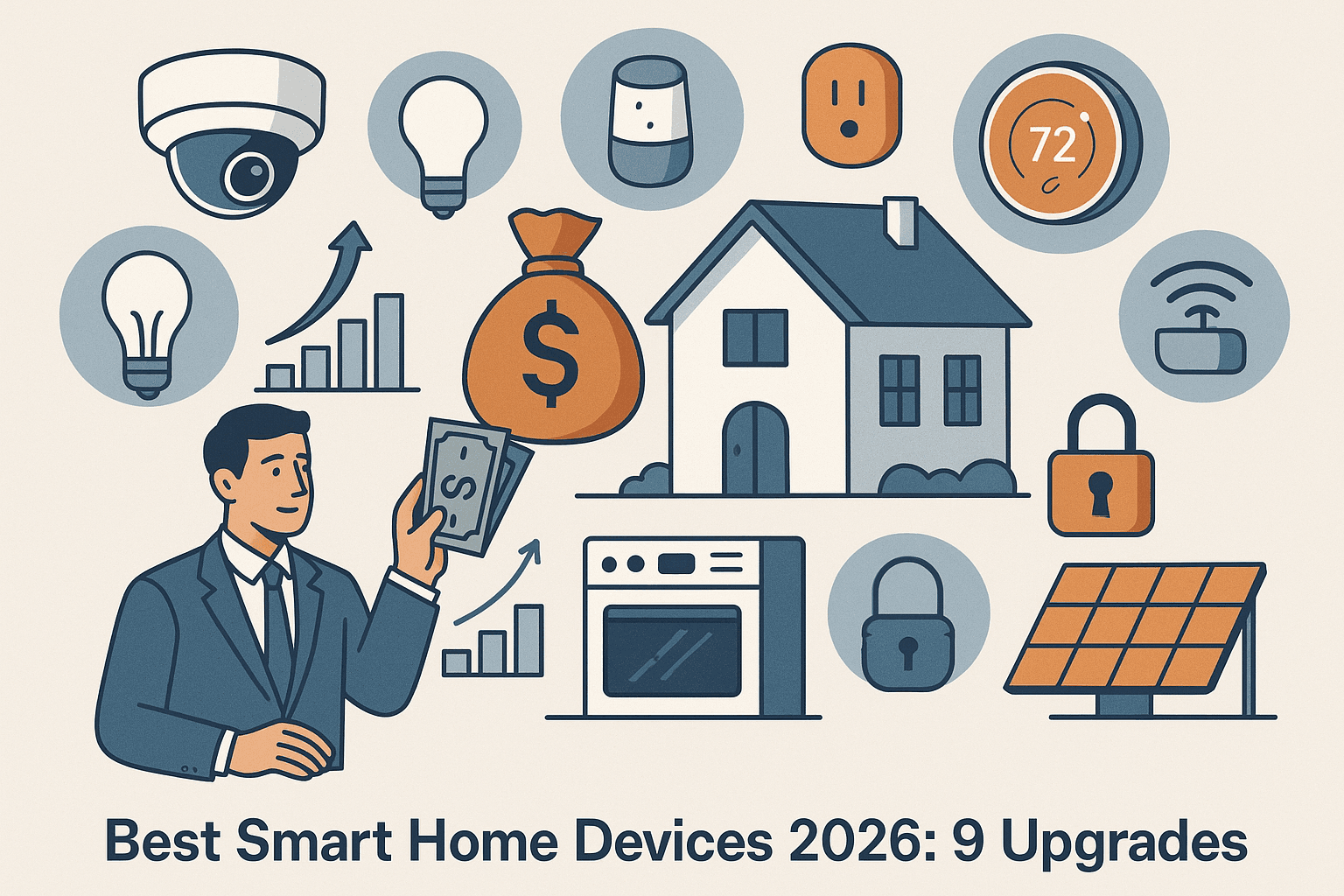
If you're shopping for the best smart home devices in 2026, start with a smart thermostat — the Ecobee SmartThermostat Premium saves most households $150–$200 per year and pays for itself in under 18 months. We evaluated 9 device categories based on documented energy savings, home value impact, and real payback periods. This guide focuses on ROI, not gadget novelty — every pick on this list delivers measurable financial return.
We scored each category on four criteria:
| Criteria | Weight | Why It Matters |
|---|---|---|
| Payback period | High | How quickly the device recoups its cost |
| Annual savings | High | Documented energy or insurance reduction |
| Home value impact | Medium | Effect on appraisal or resale |
| Installation complexity | Medium | DIY-friendly vs. professional install required |
Data sources: Department of Energy, ENERGY STAR program data, NAR homebuyer survey (2025), Insurance Information Institute, and manufacturer-published efficiency claims.
Best for: Homeowners in climates with defined heating and cooling seasons
Average cost: $150–$250 installed
Avg. annual savings: $150–$200
A smart thermostat is the single highest-ROI smart home device available in 2026. The Ecobee SmartThermostat Premium and Google Nest Learning Thermostat both qualify for a 30% federal tax credit under the Inflation Reduction Act (up to $150), bringing net cost under $100. EPA data shows properly configured smart thermostats cut HVAC energy use by 8–12% annually. Payback period: 12–18 months. See how smart thermostats stack up against other energy-efficient home improvements that qualify for tax credits in 2026.
Homeowners with central HVAC systems in seasonal climates (Northeast, Midwest, South). Not the right fit for homes using window units or radiant heat, where savings are minimal.
Best for: Homeowners wanting verified deterrence without monthly monitoring fees
Average cost: $100–$250
Insurance discount potential: 5–15% on home security rider
Video doorbells (Ring Battery Doorbell Plus, Arlo Essential) deter package theft and provide documented evidence for insurance claims. A 2024 University of North Carolina study confirmed doorbell cameras reduce break-ins at equipped homes by 25% when visible. Many insurers offer 5–15% discounts on home security endorsements for homes with camera systems — worth $30–$120/year on most policies.
Any homeowner with a covered front entry. Especially valuable in urban/suburban areas with higher package theft rates. Skip the wired version if your home lacks existing doorbell wiring.
Best for: Rentals, households with kids, frequent service providers
Average cost: $150–$300
Avg. annual value: $80–$150 (locksmith prevention + insurance discount)
Smart locks (Schlage Encode Plus, Yale Assure Lock 2) eliminate the ~$150 average locksmith call and let you issue time-limited codes to housecleaners, dog walkers, or guests. NAR's 2025 homebuyer survey found 72% of buyers ages 25–45 view smart locks as a desirable feature. Payback period depends on lockout frequency, but households with frequent service providers typically recover cost within 2 years.
Landlords, Airbnb hosts, and homeowners with multiple service providers. Less compelling for single-occupant homes with stable routines.
Best for: Anyone with a water heater, washing machine, or basement
Average cost: $20–$60 per sensor
Avg. claim prevented: $11,000 (Insurance Information Institute average water damage claim)
Water damage is the second most common homeowner insurance claim at an average of $11,000. A $30 Govee or Moen Flo sensor placed under sinks, behind appliances, and near the water heater sends an immediate phone alert at first moisture detection. Some insurers offer 3–8% policy discounts for documented leak detection systems.
Every homeowner — full stop. The $20–$60 cost vs. $11,000 average claim makes this the clearest ROI case on this list. Prioritize placement under the water heater and washing machine.
Best for: Households replacing incandescent or CFL bulbs
Average cost: $8–$15 per bulb
Annual savings: $50–$100 for average home
LED smart bulbs (Philips Hue, LIFX, Govee) use 75% less energy than incandescent bulbs and last 15–25 years. The energy savings are well-documented by ENERGY STAR: replacing 15 incandescent bulbs with LEDs saves approximately $50/year. Smart scheduling (auto-off when you leave, dimming at night) adds another 10–20% on top of baseline LED savings.
Homeowners replacing aging incandescent or older CFL fixtures. If you already have LED non-smart bulbs, the incremental savings are modest — prioritize higher-ROI upgrades first.
Best for: Home offices, entertainment centers, older appliances
Average cost: $10–$30
Annual savings: $30–$80
The average U.S. home wastes $100–$200/year on "vampire power" — energy consumed by devices in standby mode. Smart plugs (Kasa EP25, Amazon Smart Plug) let you schedule off times and monitor real-time energy draw. The Kasa EP25 pays for itself in 3–6 months when used on high-draw devices like gaming consoles, older TVs, or space heaters.
Home office workers with multiple monitors and devices in standby, and households with older electronics that lack native energy-saving modes.
Best for: Monitoring entry points, detached garages, and driveways
Average cost: $50–$200 per camera
Insurance discount: 5–15% on security endorsement
Outdoor smart cameras (Wyze Cam v4, Arlo Pro 5S, Google Nest Cam) provide 24/7 recording with motion-triggered alerts. Unlike dedicated security systems, modern cameras require no professional monitoring contract. Wyze delivers solid 2K resolution and color night vision for under $40 — making it the highest-value entry point in smart home security.
Homeowners with detached garages, driveways, or side entries without natural sightlines from the street.
Best for: Households with pets, hardwood floors, or high-traffic areas
Average cost: $200–$600
Time value: 2–4 hours/week at $15–$25/hour = $1,500–$5,000/year
Robot vacuums (Roomba j7+, Roborock S8) don't generate direct energy savings, but the time value is real. A household running a scheduled robot vacuum 5 days/week saves 2–4 hours of cleaning time weekly. At a conservative $15/hour, that's $1,500–$3,000/year in reclaimed time. The j7+ avoids obstacles with camera-based AI — meaning it won't eat charging cables or socks.
Pet owners and households with young children where floor debris is constant. Less compelling for homes with mostly carpet and no pets.
Best for: Current or prospective EV owners
Average cost: $400–$800 installed
Fuel savings: $1,200–$1,800/year vs. gasoline
With 40% of new car purchases expected to be EVs by 2027 (BloombergNEF), installing a Level 2 charger (ChargePoint Home Flex, Emporia Vue) now positions your home ahead of buyer expectations. Level 2 charges most EVs overnight at 25–50 miles of range per hour vs. 3–5 miles/hour on standard 120V. The IRS Alternative Fuel Vehicle Refueling Property Credit covers 30% of installation costs (up to $1,000) through 2032. If you're also exploring solar, review our solar panel installation cost guide to see how EV charging pairs with home energy generation.
Current EV owners or households planning to purchase one within 3 years. Also a strategic investment if you're within 5 years of selling in a market with high EV adoption (California, Colorado, Pacific Northwest).
| Device | Avg. Cost | Annual Savings/Value | Payback Period | DIY Install |
|---|---|---|---|---|
| Smart Thermostat | $150–$250 | $150–$200 | 12–18 months | Yes |
| Video Doorbell | $100–$250 | $30–$120 (insurance) | 1–3 years | Yes |
| Smart Lock | $150–$300 | $80–$150 | 2–3 years | Yes |
| Leak Detector | $20–$60 | Claim prevention | Immediate | Yes |
| Smart LED Lighting | $8–$15/bulb | $50–$100 | 12–24 months | Yes |
| Smart Plug | $10–$30 | $30–$80 | 3–6 months | Yes |
| Security Camera | $50–$200 | $30–$120 (insurance) | 1–3 years | Yes |
| Robot Vacuum | $200–$600 | Time value | 1–2 years | Yes |
| Level 2 EV Charger | $400–$800 | $1,200–$1,800 | 6–12 months | No |
This guide draws on data from the U.S. Department of Energy, ENERGY STAR, the Insurance Information Institute, NAR's 2025 Profile of Home Buyers and Sellers, and BloombergNEF EV forecast data. We excluded voice assistants and smart displays from this ranking because their ROI is primarily lifestyle-based rather than financial. Last updated: May 2026. We review this guide every six months as device pricing and energy rates change.
A smart thermostat delivers the best documented ROI in 2026 — saving $150–$200/year on HVAC costs with a net cost under $100 after the 30% federal tax credit. Most households recover their investment in 12–18 months.
Yes. NAR data shows smart home features — particularly smart thermostats, security systems, and EV chargers — are valued by 72%+ of buyers under 45. A Level 2 EV charger adds an estimated $1,500–$2,500 to appraised value in high-EV adoption markets.
Smart thermostats qualify for the Nonbusiness Energy Property Credit (30%, up to $150) and Level 2 EV chargers qualify for the Alternative Fuel Vehicle Refueling Property Credit (30%, up to $1,000) through 2032 under the Inflation Reduction Act.
Most smart home devices are DIY-friendly — thermostats, doorbell cameras, smart locks, leak detectors, smart plugs, and smart bulbs all install without professional help. The only exception on this list is the Level 2 EV charger, which requires a licensed electrician to run a 240V circuit.
Smart water leak sensors ($20–$60) offer the highest loss-prevention value per dollar spent. A single prevented water damage claim ($11,000 average) represents a 180x return on a $60 sensor.
Yes. Most major insurers offer 5–15% discounts on security endorsements or riders for homes with camera systems, smart locks, and leak detection sensors. Contact your insurer to verify what qualifies under your specific policy.
Start with a smart plug ($15) to understand your phantom load, add a leak sensor ($30) under your water heater, then invest in a smart thermostat once you're ready for a larger purchase. These three devices cost under $100 combined and deliver immediate, measurable savings.
Most smart home devices require Wi-Fi for remote control and scheduling. However, smart locks with keypads, video doorbells with local storage, and robot vacuums with onboard scheduling continue to function locally during outages — they just won't send notifications or allow remote access.
This content is for informational purposes only. Device pricing, energy rates, and insurance discounts vary by region and change frequently. Federal tax credit eligibility depends on your individual tax situation — consult a tax professional before making purchasing decisions based on credit availability. Some links on this page may be affiliate links. This does not influence our rankings — our methodology is described above.
Compare six roofing materials by lifespan, installed cost and climate fit. See why asphalt shingles win on value and standing seam metal wins on longevity.
Read MoreCompare 8 types of roof repair providers for 2026, from manufacturer-certified contractors to local roofers, with costs, warranties and vetting tips.
Read MoreA roof inspection can cost nothing or several hundred dollars, and the difference is who is paying attention to what. We ranked eight options — independent certified inspectors, drone and aerial reports, contractor visits, and municipal programs — on independence, depth, documentation, and cost.
Read More