
Ant Control in Dallas: How to Get Rid of Ants
Ant control in Dallas requires a strategic, year-round defense against species like fire ants, carpenter ants, and odorous house ants, which thrive in the city’s humid subtropical climate and active s...
Need Help? Call Now for Free Estimate
Speak with a local expert today
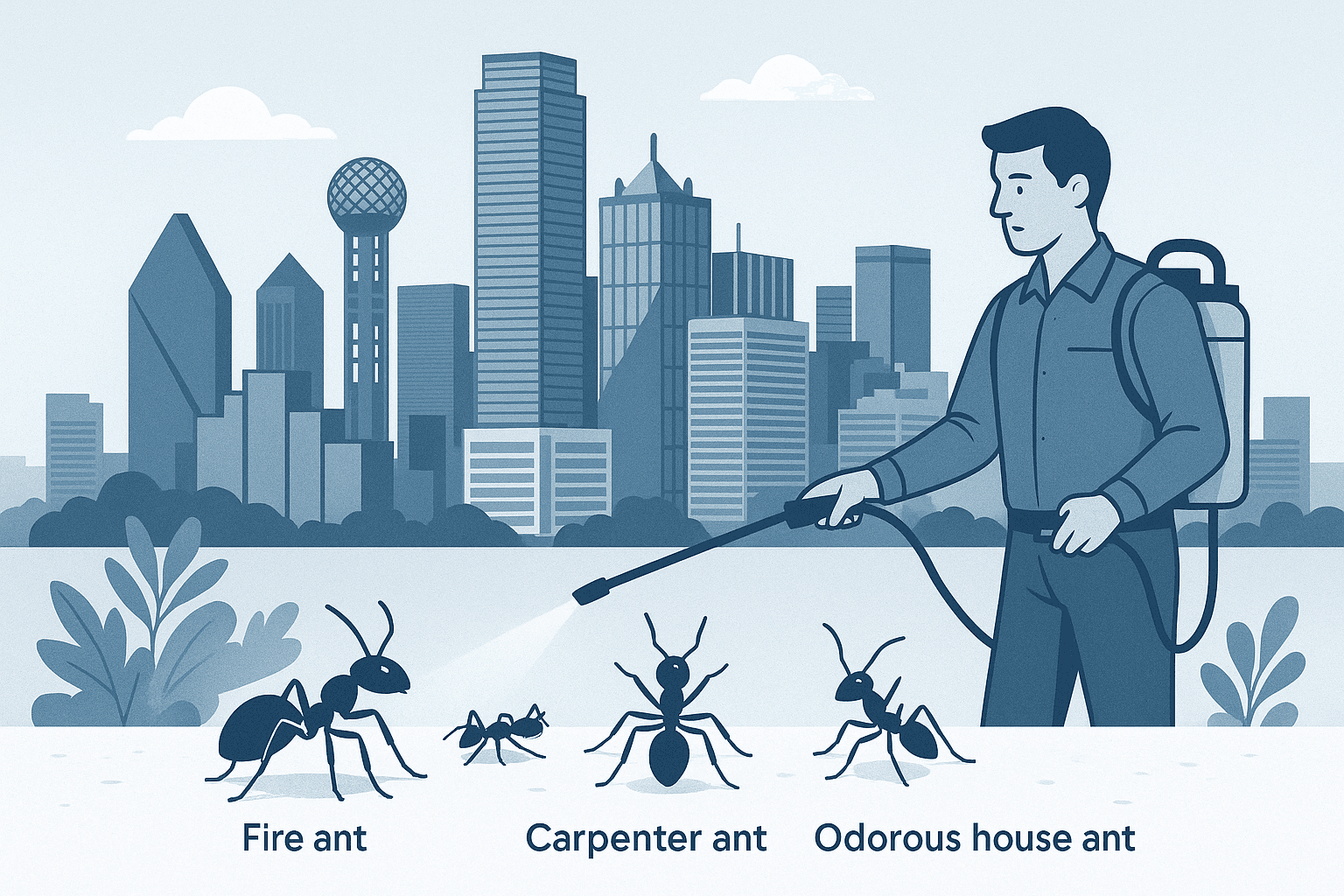
Ant control in Dallas requires a strategic, year-round defense against species like fire ants, carpenter ants, and odorous house ants, which thrive in the city’s humid subtropical climate and active soil. The direct answer is that effective control is not a one-time spray but a multi-phase process: a thorough inspection to identify the specific ant and its nest, targeted treatment of the colony at its source, and the implementation of environmental modifications to make your property less inviting. For Dallas homeowners, this means understanding that local weather patterns—from spring rains to summer heat—directly drive ant behavior, turning your home into a target for food, water, and shelter. Success hinges on professional expertise that combines immediate intervention with long-term, preventative strategies tailored to North Texas conditions.
Why Dallas is a Battleground for Ants
To understand ant control here, you must first understand the Dallas ecosystem. Our climate is essentially an open invitation. The hot, humid summers provide ideal conditions for ants to forage and breed rapidly, while the typically mild winters rarely deliver a sustained, colony-killing freeze. Spring and fall rains don’t just hydrate the landscape; they flood ground nests, sending scouts and entire colonies seeking higher, drier ground—often right into your foundation walls or under your slab.
The soil composition in many Dallas neighborhoods, from the clay-heavy ground in Lakewood to the sandy loam found in parts of Frisco, creates a perfect labyrinth for tunneling. Furthermore, the urban environment itself is a factor. Lush, irrigated lawns in Preston Hollow, dense tree canopies in Lake Highlands, and the ubiquitous flower beds across the city provide ample food sources in the form of honeydew from aphids and other insects. Our homes then complete the picture, offering coveted resources: a drop of syrup on a kitchen counter, pet food in a garage, or even condensation around a pipe in a crawl space becomes a high-value target for a scout ant to report back on.
Consider the common odorous house ant. To a homeowner in Bishop Arts, a trail of tiny black ants across the kitchen island seems like a random nuisance. But to a pest professional, that trail is a highway. It leads from a satellite colony likely nestled under the mulch of your landscaping, back to a main colony that could be under a neighbor’s patio slab. Treating just the ants on the counter is like fixing a leak by mopping the floor; the problem will return because the source remains pressurised.
The Dallas Ant Lineup: Know Your Enemy
Not all ants are created equal, and misidentification in Dallas can lead to failed treatments. The strategy for a sugar-loving thief ant is vastly different from that for a wood-destroying carpenter ant.
Fire Ants: The notorious, aggressive red imported fire ant is a public health concern across North Texas. Their mounded nests are common in sunny areas of yards in Plano, McKinney, and throughout the DFW metroplex. A disturbance results in a painful, stinging swarm that can be dangerous to pets, children, and those with allergies. Control requires specific granular baits and mound treatments, as their colonies are deep and extensive.
Carpenter Ants: Often confused with termites, these large black or red ants are a sign of moisture problems. They don’t eat wood but excavate it to create smooth galleries for their nests. In Dallas neighborhoods with mature trees like University Park or older homes in East Dallas, they often start in a water-damaged window frame, a rotting fence post, or a tree limb touching the roof. Seeing them indoors, especially at night, is a red flag for a potentially damaging satellite nest within the structure itself.
Odorous House Ants & Argentine Ants: These are the typical "kitchen ants." Small, dark, and prolific, they form massive super-colonies with multiple queens. They are the ultimate opportunists, exploiting the tiniest crack in a foundation in Lakewood to follow scent trails into your pantry. Their nests can be incredibly hard to locate, as they often shift locations in response to moisture and temperature.
Acrobat & Pavement Ants: Common invaders from slab foundations. You’ll often find pavement ants colonizing the cracks in your driveway or along sidewalk edges in Uptown. Acrobat ants, named for how they raise their abdomen when disturbed, frequently enter homes via utility lines or branches, seeking sweet substances and proteins.
The critical insight here is that the ant species dictates the protocol. A broadcast spray around the perimeter might repel a pavement ant for a week, but it will do little to penetrate a deep fire ant mound or eliminate a carpenter ant colony nesting in your wall void. This is where professional diagnosis moves from a convenience to a necessity.
The Professional Process: More Than Just a Spray
When a reputable Dallas pest control company approaches an ant problem, they follow a disciplined, investigative process. It’s less like applying a bandage and more like a doctor making a diagnosis and prescribing a treatment plan.
Phase 1: The Forensic Inspection
A technician won’t just look at where you see ants. They will conduct a full property audit. This includes tracing ant trails to find their origin, inspecting the foundation for entry points, checking irrigation systems for leaks that attract moisture-loving species, examining mulch beds and tree lines, and looking for interior moisture issues under sinks, around windows, and in attics. They are identifying not just the what, but the why. Why did the ants choose this home, at this time, entering at this point?
Phase 2: Targeted Colony Elimination
Based on the inspection, the treatment is tailored. This is where the science comes in. For many common ants, the most effective method is a combination of judiciously applied non-repellent insecticides and insect growth regulator (IGR) baits.
- Non-repellent insecticides are applied to key zones. Unlike traditional sprays that ants detect and avoid, these are undetectable. Ants walk through the treated area, pick up the micro-encapsulated product on their bodies, and carry it deep into the nest, where it is transferred to other members, including the queen, through grooming and contact.
- IGR Baits are placed in strategic stations. These baits are carried back to the colony as food. The IGR doesn’t kill workers immediately; instead, it disrupts the development of larvae and prevents queens from producing viable eggs, effectively sterilizing the colony over time.
For species like carpenter ants, direct treatment into the nest cavity (if accessible) is often required. For fire ants, a granular bait program across the yard, supplemented by direct mound treatments, is the standard.
Phase 3: The Exclusion & Prevention Plan
Killing the current colony is only half the battle. The second half is making your Dallas home a fortress. A good technician will provide a detailed report pointing out vulnerabilities: tree limbs touching the roof, cracks in the mortar, gaps around utility penetrations, faulty weatherstripping, and areas of excessive mulch or ground cover against the foundation. They may recommend diverting downspouts, fixing leaky outdoor faucets, or storing pet food in sealed containers. This is the long-term partnership—shifting the environment to be inherently less attractive to ants.
What Happens When You Call a Dallas Ant Control Professional
If you’re considering making that call, you likely want to know what to expect. The process is designed to be straightforward, informative, and focused on solving your problem, not upselling you.
The Initial Conversation: When you call, you’ll typically speak with a knowledgeable coordinator, not just a call center. They’ll ask key questions: What type of ant are you seeing? Where are you seeing them? How long has it been going on? This isn’t an interrogation; it’s to ensure the right technician with the right tools is scheduled. They’ll explain the service process and provide a clear estimate for the initial inspection and treatment. It’s important to note that all quoted prices are estimates until a technician can complete a full on-site inspection, as the scope of the infestation can vary greatly.
The On-Site Visit: Your technician will arrive, introduce themselves, and review the issue with you. They will then perform the comprehensive inspection described earlier. You are encouraged to walk with them and ask questions—this is your education session. After the inspection, they will present their findings, explain the specific ant species involved, detail their recommended treatment plan, and provide a firm price for the service. There should be no pressure or hidden fees. A reputable company will be fully licensed and insured, and they should provide that information willingly.
The Treatment & Follow-up: Once you approve the plan, they will execute the targeted treatment. They should explain what they’re applying, why, and any precautions you need to take (like keeping pets inside for a short period). For most ant species, you will see a significant reduction in activity within 24-48 hours, with complete control often achieved within a week or two as the colony is eliminated. Many companies include a follow-up visit or guarantee period where they will return if activity persists at no additional charge, provided you’ve followed their basic prevention advice.
Investing in Peace of Mind: Understanding Cost & Value
Homeowners naturally want to know, “How much will this cost?” In Dallas, the cost for professional ant control is not a flat fee but an investment based on the size of your home, the severity and type of infestation, and the required treatment protocol. A one-time treatment for a small, localized trail of ants in a condo may be a modest investment. A comprehensive, ongoing quarterly or bi-monthly service plan for a large property in Southlake with multiple ant species and fire ants will represent a larger commitment.
Think of the cost not as a purchase of poison, but as a purchase of expertise, time, and guaranteed results. It covers the diagnostic skill, the professional-grade materials unavailable to consumers, the insurance and licensing that protect you, and the warranty of service. When you weigh it against the frustration of constant DIY battles, the potential property damage from carpenter ants, or the health risk of fire ants, professional control emerges as a pragmatic solution for long-term peace of mind.
The Dallas Homeowner’s Seasonal Ant Defense Calendar
Your role in partnership with a professional is crucial. Here is a seasonal guide to staying vigilant:
- Spring (March-May): This is peak swarming and foraging season. After spring rains, be hyper-vigilant for ants seeking shelter. Inspect your foundation, ensure mulch is kept 6-12 inches away from siding, and trim back any vegetation touching the house. This is the ideal time for a professional perimeter application to create a protective barrier.
- Summer (June-August): Heat drives ants indoors for water. Eliminate indoor moisture by fixing leaky pipes, using dehumidifiers in crawl spaces, and ensuring AC drip lines are directed away from the foundation. Keep kitchen surfaces impeccably clean and store food in sealed containers.
- Fall (September-November): Colonies are preparing for winter and are actively foraging for food. Be mindful of leaving pet food out and promptly clean up fallen fruit from trees. This is another critical time for exclusion work—sealing cracks and gaps before colder weather pushes ants inside to overwinter.
- Winter (December-February): While activity slows, it doesn’t stop, especially during mild spells. Monitor for indoor activity, particularly around windows, doors, and pipes. A winter sighting often indicates a nest is already inside the structure.
Ant control in Dallas is ultimately about changing the conditions of engagement. It’s a move from reactive frustration to proactive management. By understanding the local ant biology, partnering with a professional who uses modern, targeted methods, and maintaining a disciplined approach to home maintenance, you can reclaim your space. The goal isn’t a sterile, insect-free yard—an impossible standard in our ecosystem—but a home that is resilient, protected, and free from the intrusion of these persistent, organized invaders.
